Over the years, I've told colleagues and friends about things I have seen or experienced. Many times, people have said that I should write them down so that they won't be lost and forgotten, since some of them might be useful parts of our history. I've been writing them down, without being sure what I would do with them. I decided to gradually post them on this website, and see what reactions I get. I suggest reading from the bottom up (starting with the August 2017 post "The Meritocracy"). Thoughtful and kind feedback would be useful for me, and would help me to revise the exposition to make it as useful as possible. I hope that while you read my stories you will ask yourself "What can I learn from this?" I'm particularly interested in knowing what you see as the point of the story, or what you take away from it. Please send feedback to asilverb@gmail.com. Thanks for taking the time to read and hopefully reflect on them!
I often run the stories past the people I mention, even when they are anonymized, to get their feedback and give them a chance to correct the record or ask for changes. When they tell me they're happy to be named, I sometimes do so. When I give letters as pseudonyms, there is no correlation between those letters and the names of the real people.
Tuesday, July 31, 2018
postscript to July 25 post
Wednesday, July 25, 2018
A mountain of unwashed coffee cups
I visited a mathematics research institute in Bonn, Germany sometime in the 1990s. In addition to offices, each floor had a small kitchen with ceramic coffee cups, coffee-making equipment, and a prominent sign stating that everyone was responsible for washing their cups after use. So I was surprised to find a mountain of unwashed coffee cups piled in the sink.
Wednesday, July 18, 2018
My Brilliant Friend
Wednesday, July 11, 2018
Math, not people
W asked me to join him and several others on the organizing committee for a research program to take place at a mathematics institute. The pre-proposal, which W and another organizer had already written, was due in a couple of days. My guess is that I was added to the committee at the last minute as its "token woman".
Thursday, July 5, 2018
"You must be mistaken!"
When I told American colleagues about a certain result, and mentioned that I had proved (and published) it, the knee-jerk reaction was "Oh, that's obvious." I grew accustomed to that response.
Friday, June 29, 2018
"Foreigners are golden"
Saturday, June 23, 2018
Photocopying exams
This blog post is part of a series designed to give some of the backstory for an upcoming post.
Saturday, June 16, 2018
"Alice, Professor X is here in my office."
Sunday, June 10, 2018
A test of character
Saturday, June 2, 2018
Examples of small groups
W, an undergraduate math major, was having trouble in the algebra course she was taking. In desperation she asked a professor she knew, Robert Gunning, what she should do. He told her to contact me, because I was an algebraist. Plenty of male grad students were algebraists; I don't think it was a coincidence that Gunning sent her to one of the few female grad students. W was the only female student in the algebra class.
Saturday, May 26, 2018
"Name one!"
Friday, May 18, 2018
Stage whisper
Professor Q was supporting candidate Y and I was supporting candidate X, for a postdoc position.
- Almost all the candidates I had supported since I arrived at Ohio State were male.
- All of the candidates he had ever supported were male.
- No one accused him of only supporting his candidates because they were male.
Monday, April 16, 2018
"I'd be happy to hire her if she were male."
Saturday, March 31, 2018
"Don't tell anyone you have this!"
The following post is reminiscent of the January 15, 2018 post.
Sunday, March 25, 2018
J. SMITH and Miss Jane DOE
Tuesday, March 20, 2018
Three Reasons
- The first is that you're a woman. The other students are reserved Englishmen who are shy about speaking to women, so they won't speak to you.
- The second reason is that you're American. They're not accustomed to speaking to foreigners, so they won't speak to you.
- And the third reason is that they don't speak to anyone. So they certainly won't speak to you.
Saturday, March 10, 2018
Math Hookers in the House of Ill Repute
Sunday, February 25, 2018
"They don't have a history of sending students to Princeton"
Saturday, February 17, 2018
They knew the law and obeyed it
Sunday, February 11, 2018
A quick way to reject a paper
Saturday, February 3, 2018
The rules of the game
Monday, January 29, 2018
How do I know how good it is, if I don't know who wrote it?
Tuesday, January 23, 2018
"HIRE ME!"
Dr. Silverberg:The Hiring Committee has met and made its decision. It is not good for you. We will not be making an offer to you.
Dear T,Although I haven't been asked for feedback on my job interview, I thought it might be useful to give feedback on one aspect.Much of my interview with the hiring committee consisted of discussing the question of how to hire more women. In retrospect, my feelings about having been asked that question, and then been rejected for the position, are negative. By the way, I gave standard, well-known answers to that question, but was left with the impression that some of the committee reacted to my response defensively and negatively.I hope that this feedback is helpful for your future job searches.Best regards,Alice
Friday, January 19, 2018
Personal Questions
Monday, January 15, 2018
Don't tell anyone. They'll be jealous.
Monday, January 8, 2018
They melted like butter
Z came to my office hours to ask for help with her homework. As usual, I used the Socratic Method. I asked her questions designed to help her figure out the answers herself, so that she'd have the skills she would need to solve problems on her own.
But rather than answering my questions, she was silent. I looked up from the textbook. Z was batting her eyelashes at me. I don't know if anyone ever batted their eyelashes at me before, but this was unmistakable.
I ignored the batting, and continued as before. Z got more and more flustered and confused. She expected me to give her the answers to the homework problems, and didn't understand why I wasn't doing so.
I looked more closely. I saw an ordinary-looking female Ohio State undergraduate student. Dyed blond hair, lots of makeup, low-cut blouse. Quite a lot of mascara on the batting eyelashes.
I continued to treat her the same way I would have treated any student (of any gender). But I realized what was going on. She was doing exactly what she had always done at office hours to get the instructor to tell her the answers. I must have had colleagues who melted like butter, and she expected me to do the same.
If Z had thought of it as flirting, she might have realized why it had worked on some of my (male) colleagues. My colleagues had trained her to act in a way that gave her the homework solutions, and she had learned that lesson well. Her confusion told me that she knew that it (usually) worked, but didn't understand why.
I don't think she came back to office hours. I worried about Z---that someone would take advantage of her naivety. But it would have been hard to give her helpful life advice, while staying within the boundaries of our professional relationship.
Wednesday, January 3, 2018
The Letter
I used to point out how few women were invited to participate in conferences at the Oberwolfach mathematics research center, until someone said to me "If you weren't invited to Oberwolfach, it must be because you're not good enough to be invited."
From this and many similar experiences, I learned that my observations and suggestions are more likely to have a positive effect when I don't stand to benefit. I have more credibility when I'm the only female invited speaker, than when there are no female speakers.
It's more effective when someone else speaks up on your behalf.
But when the speaker list is all male and probably shouldn't be, who should speak up?
In 2006, at my suggestion the Association for Women in Mathematics enacted a policy that anyone can ask the AWM President to send a letter to organizers of a conference reminding them of the benefits of considering potential speakers from a wide pool so that good people are not overlooked (if not for their current conference, then for future ones). Suggestions included having a diverse organizing committee, making an effort to think of potential speakers whose demographics, mathematical interests, or geographical areas aren't represented on the organizing committee, using the Mathscinet searchable database to check that important areas or people aren't overlooked, and contacting colleagues and organizations that could help suggest names or ways to go about finding them. We referred to it as "The Letter" (as in "I wonder if those conference organizers might benefit from being sent The Letter").
Saturday, December 30, 2017
It's the ones who know better
Sometimes, the people who disappoint you the most aren't the ones who do the wrong thing; it's the ones who know better, but don't stand up for what's right.
Before deciding on the next math department Chair at Ohio State, the Dean interviewed all the tenured and tenure-track faculty, one by one. He reported that the main concern of the faculty was a lack of collegiality. He said that three names recurred in the interviews. Around the (purely metaphorical) water cooler we asked each other "Who's the third?" Not because we couldn't think of a third one, but because there were several possibilities.
Of the three "non-collegial" faculty, the first two were obvious. One I'll call Nick Machiavell (not his real name). Soon after I arrived at OSU, Nick told me the useful and important observation that "collegiality" is a codeword that academics use to marginalize people they don't like. While there's a lot of truth in that, it was also an excuse Nick used to ignore criticism of his behavior.
For example, Nick often disagreed with our colleague Greg, but he might phrase it by stating that Greg was stupid. Greg recalls standing up at a faculty meeting and asking everyone, "why do you put up with this behavior?" After one of the times that Greg pushed back, Nick implemented a new strategy. Right after Greg said Y at a faculty meeting, Nick, rather than calling Greg stupid, said that anyone is stupid who says Y.
Nick and I often had the same views on what the right outcome should be. But he and I had very different views on how to achieve that outcome. Nick became so unpopular in the math department that when some of us (including Nick) wanted X to happen, the best strategy was to try to prevent Nick from attending the meeting at which X was discussed.
Hamlet Prince (not his real name) was well educated, well spoken, and well respected by his colleagues. Ham wanted the department to hire R for one of our postdoc positions. R had a strong file. Nick told me that he was against the appointment, since "eastern Europeans are lazy --- they stop working after you hire them." Nick added that he knew this was an "illegal reason" to not hire someone, but that he'd deny saying it, if I told anyone.
I let Ham know that I and others would support his proposal to hire R, despite Nick's objections (which Nick had also told Ham, "illegal reason" and all). However, Ham (who was a tenured full professor) told me he decided to back down since standing up to his colleagues wasn't in his best interests.
Without the strong support of Ham, who was closest to R's field, the department wouldn't offer a postdoc position to R. While I understand the need to pick one's battles, I wished that Ham would choose to fight more of them.
Greg was eventually so miserable at OSU that he accepted a job offer elsewhere. Shortly before he left, I asked Greg if Nick drove him out. He replied that it wasn't the Nick Machiavells of the department who drove him away, it was the Hamlet Princes. It's the ones who know better, but aren't willing to do the right thing.
Tuesday, December 26, 2017
"There are no blacks in Ohio"
When I arrived at Ohio State University in 1984, OSU's student body looked much more homogeneous than those of Harvard and Princeton. It seemed as if most of the female students dyed their hair blond, and most of the male students wore baseball caps (often backwards). But what I found most striking was that the students seemed almost uniformly white. Even Princeton, with its history of "eating clubs" that at various times discriminated against women, Jews, Catholics, and people of color, looked racially diverse compared to Ohio State. I asked a colleague why this was. The answer was "there are no blacks in Ohio." As I drove east from campus to the Columbus airport through miles and miles of African American neighborhoods (before Interstate 670 was completed), I wondered what that really meant.
Until 1987, OSU had open admissions; I was told that all you needed to get in was an Ohio high school diploma. In 1987, OSU raised its academic standards for admission to the Columbus (flagship) campus, basing it on grades, test scores, and minimum course requirements. Looking around campus, it seemed to me that the number of students of color went up. When I've told people this, they've immediately tried to correct me: "No, you mean the number went down."
I mean it went up. Enough for me to notice. Why was that? I asked around, and was told that open admissions at Ohio State had been on a first-come, first-served basis. Submitting an application by the publicly stated deadline wasn't soon enough. The high school students from the wealthy white suburbs were told by savvy guidance counselors the date by which they needed to submit their college applications in order to be accepted to the main campus of Ohio State. The inner city schools didn't have that information.
Open admissions policies often have noble goals of equal access. But to achieve equal opportunity and equal access, one needs equal information.
Friday, December 22, 2017
A Response to Feedback
While many of my stories thus far are from the 1980s or 1990s, for almost all of them I could tell very similar stories that happened recently.
I've postponed some tales of recent incidents since they're more problematic to write about. In some cases, I still need to work with the people involved. For some, I might be able to make more of a difference behind the scenes, rather than making the stories public now. And for some of the recent stories, and all of the more serious incidents, I would like to distance myself from them a little more so that I can write about them in a way that's helpful and compassionate. I'm hoping that readers will stick around as I figure out how to do that!
It's interesting that some people consider the stories to be horrifying or depressing. I've mostly posted stories I find amusing; I haven't yet written about the more extreme incidents that seriously and negatively impact someone's life or career. Those are still to come!
Friday, December 1, 2017
Why is this job candidate like a writing-desk?
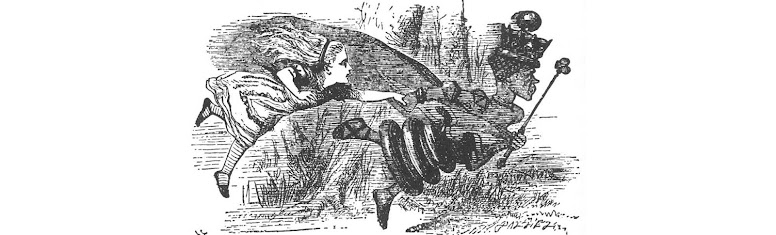
Mr. Big had big demands, according to the department Chair who was trying to hire him. He wanted a large salary, an ample slush fund, a nice office, and a tenure-track assistant professorship for his wife. The Chair told the math faculty this last demand as if it were equivalent to negotiating for a large desk. Lewis Carroll asked "Why is a raven like a writing desk?" I wanted to ask "Why is this woman like a writing desk?"
It was one of the first departmental hiring committee meetings since I arrived at Ohio State. Mr. Big's qualifications were stellar, but my colleagues were worried that he was too much of an "operator" and that things might sour after we hired him. We didn't discuss the qualifications of "Mrs. Big." The Chair's case for her was "If we want Mr. Big we have to hire his wife. If we later decide that we don't like him, we just won't give her tenure when she comes up for it." In other words, if we don't like him, we can get rid of them both in six years by kicking her out, independent of her qualifications for tenure.
I was new and didn't know the rules, but I was pretty sure this wasn't in the tenure rulebook. If it went unchallenged, did that mean it was being agreed to? As the faculty member with the lowest seniority, I didn't want to risk my own chances for tenure by speaking out; I signaled to others more senior than me, but they didn't want to get involved.
Finally, I raised my hand and said meekly, "I'm sitting at the back where it's hard to hear. Perhaps I heard wrong. Surely we wouldn't deny her tenure just because we don't like him?" The chair of the hiring committee quietly and briefly said something about how we wouldn't do that.
The next day I ran into the department Chair's wife, while she was photocopying his exams for the course they were both teaching. (She had recently earned a PhD in mathematics education and was a lecturer in the math department.) She had heard that I had challenged the department Chair at a faculty meeting. She told me that wasn't in my best interests.
She had been friendly to me in the past. She had told me tales of growing up in Brooklyn, and learning that her family was in the Mafia---she'd complain about some bully and the next day her cousins would break his kneecaps.
Sometimes there's a fine line between friendly advice and a threat. I was very protective of my kneecaps for the next few weeks.
The committee voted for a fancy job for him (they could hardly not; he was Mr. Big after all), but only a temporary instructorship for her. While these may have been the correct decisions based on their qualifications, someone told me that it was merely a face-saving way of saying no to him. The department Chair, embarrassed about not meeting Mr. Big's demands, went against department rules and didn't make either offer.
I never found where in the rulebook it said that we could deny someone tenure because we don't like her husband, but maybe that's because I hadn't been given a tenure rulebook. Thankfully, my kneecaps are still intact.
Tuesday, November 21, 2017
The Obvious Suspect
Professors P and Q sat across from me in the mathematics common room at the University of Cambridge. They were American professors, visiting the UK from a large midwestern university. I was an American student, visiting Cambridge on a fellowship for the 1979-1980 academic year. I was reading a mathematics text, trying to mind my own business.
P and Q were deep in discussion, trying to answer the question "Why are there so few female mathematicians?" Since they were Americans, I could hear every word.
They examined the premise that it was due to prejudice and discrimination. They rapidly dismissed that, on the grounds that the people in power in mathematics were just like them, and they were obviously good people who couldn't possibly unfairly discriminate or succumb to prejudice. Much as I tried not to eavesdrop, from that point on I felt as if I were listening to two bumbling detectives trying to solve a murder mystery. They had ruled out the obvious suspect. Who were they going to declare to be the culprit, and how were they going to get there? I had heard such debates many times before, so I had my suspicions about where they were heading. Nonetheless, I ardently hoped for better.
They eliminated one premise after another. Could it be lack of opportunities? Surely not. Lack of interest? Well, maybe, but that wouldn't fully account for it. They considered everything they could think of, until they were left with only one option.
At that point, I just couldn't restrain myself. It was clear what they were about to say, and I didn't want them to say it. Too many times had I heard (always male) professors conclude that women weren't as good at mathematics because they were genetically inferior.
I introduced myself to P and Q, apologized for listening to their conversation, and told them that the answers to their question were prejudice and discrimination. (Actually, it's likely I told them there were three reasons: "discrimination, discrimination, and discrimination", alluding to the adage about real estate and location.) I pointed out that Ivy League universities had only recently begun to admit women, and were, even then, doing so in small numbers. I told them some recent stories about Harvard, from personal experience. And I pointed out some facts about the recent history of (and discrimination against) women at Cambridge.
I don't know whether any opinions changed. Their minds were probably made up before they started. But they listened politely, even though I disagreed with them. (I wish that happened more often nowadays!)